
What Is an Options Overlay—and Why High-Net-Worth Investors Are Using Them
Are you feeling stuck between holding and selling stocks, bonds, or ETFs? An Options Overlay adds a strategic layer to help manage risk, generate income, and diversify without disrupting your existing portfolio.
Volatility, concentration, and tax implications are all key factors for deciding whether to hold or sell. High-net-worth investors are particularly susceptible to concentrated stock positions, and the sale of large unrealized gains can come with tax consequences if not done strategically.
An options overlay is a strategy applied on top of an existing investment, while the underlying portfolio remains intact. With this strategy, there is no forced liquidation, and it can be utilized to pursue a specific goal like managing risk, income, or enhancing protection. As we like to say, an Options Overlay and your existing portfolio might just be “better together”.
Here is a preview of some common goals that Option Overlays can help to address:
Common Goals for Options Overlays
Managing Concentrated Stock Risk
Options Overlays can be used strategically to assist with concentrated stock risk, including tax-neutral liquidations:
Reducing exposure without immediately selling
Potentially generating income while pursuing diversification
Helpful for executives, founders, and legacy stockholders
Downside Protection in Volatile Markets
Options Overlays can be used strategically to offer downside protection for your portfolio that aligns with personal comfort and goals, including:
Income offset
Protective bands
Defined downside floors
Generating Income Without Chasing Yield
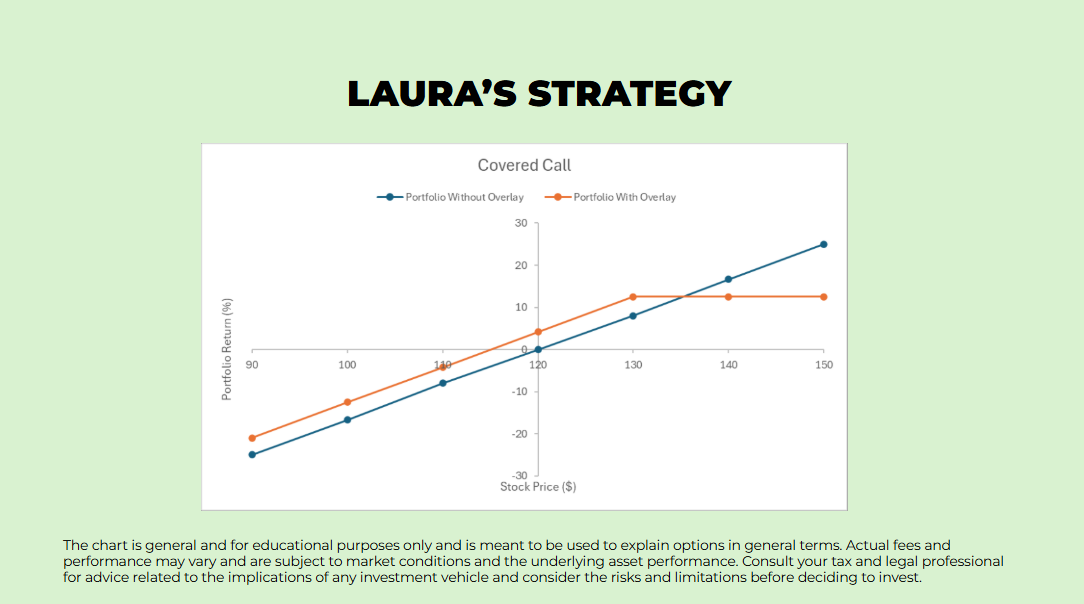
Options Overlays can be used strategically to prioritize generating income option premiums, while limiting some upside potential:
Using option premiums as an income source
Limiting some upside in exchange for consistency
Particularly attractive in sideways or uncertain markets
Case Study: Concentrated Stock Risk
Let’s look at Laura’s use of an Options Overlay to manage concentrated stock risk:



Is an Options Overlay right for you?
Options Overlays are often best suited for high-net-worth investors with complex financial situations—particularly those with concentrated holdings or significant unrealized gains who are seeking greater flexibility without disrupting long-term plans. These strategies can appeal to investors who value customization, tax awareness, and proactive risk management over simplicity.
That said, options overlays are not appropriate for everyone. They involve tradeoffs, ongoing oversight, and a level of sophistication that may not align with every investor’s goals or preferences. Determining whether an options overlay makes sense requires evaluating the full financial picture, rather than focusing on any single investment decision in isolation. Our team can work with you to determine if this strategy makes sense for your short and long-term goals.
Strategic Considerations
Despite common misconceptions, options overlays are not speculative trading strategies. They are structured, rules-based approaches designed to support specific planning objectives—such as managing risk, generating income, or creating greater predictability—without relying on short-term market timing.
Effective implementation begins with a deep understanding of the existing portfolio, including concentrated positions, cost basis, time horizon, and tax considerations. Strategies are highly customized and actively monitored, and they are often implemented as part of a collaborative planning process alongside CPAs, attorneys, and other trusted professionals. This coordination helps ensure the strategy complements the broader financial plan and supports a more intentional, streamlined approach to wealth management.
If you’re looking for more information on how Options Overlays may be used in your specific financial plan, feel free to contact us today.
Disclaimer: This material is provided for educational and informational purposes only and is not intended as investment, legal, or tax advice. Options strategies involve risk and are not suitable for all investors. There is no guarantee that any strategy will be successful or achieve its intended objectives. Investment outcomes depend on market conditions, individual circumstances, and the structure of the strategy. Investors should consult with qualified financial, tax, and legal professionals before implementing any investment strategy discussed herein.