
Treasury Bond Yields: What's Driving the Surge, and Why It Matters
Imagine you're at the gym, working your way up through heavier and heavier weights. You're strong, so you can lift the big plates—once, three times, five times. But somewhere around rep seven, you feel it: your arms start to wobble. Each rep gets harder. Your form starts to slip. You'll probably still get to ten, but there's a real chance your strength gives out first.
That's a useful way to think about what's happening with bond yields right now, and how they connect to both the economy and the stock market.
By this point, you've likely seen at least one headline about bond yields this year—and those headlines have only intensified in recent weeks. The stock market is strong and the economy is able to bear a lot of weight, but that weight is getting heavier and harder to lift, in the form of bond yields rising to heights we haven't seen in years.
The bond market doesn't get talked about as often as stocks, but it may be even more important to the economy. Most of the time, bonds—specifically, U.S. Treasury bonds—hum along quietly in the background as the backbone of the entire financial system. Every so often, though, they demand the spotlight. This is one of those times.
Below, we break down what bond yields are, why they matter, why they're rising, and what it might mean for you.
Why Are We Talking About Bonds Right Now?
Bond yields have been rising quickly for several months. In May, the yield on 30-year Treasury bonds hit their highest level since 2007, and after dipping briefly, climbed even higher. The 10-year Treasury yield took a little longer to make headlines, but it recently hit a 19-year high, reaching nearly 5% on September 15.¹ These spikes have caused volatility in the stock market and prompted a flurry of action in Washington.
What Are Bond Yields, and Why Do They Matter So Much?
When you buy a bond, you're essentially lending money to the bond's issuer. In return, the issuer promises to pay a specified rate of interest on a regular basis, then repay the original amount after a set length of time.
A bond's yield is the return an investor expects to earn until the bond matures. Yields can be calculated by dividing a bond's annual interest payment by its price. For example, imagine an investor—we'll call him Alfred—buys a bond with a 10% interest rate for $1,000. The bond's yield is 10%. Now imagine Alfred sells that bond to Ethyl a year later for $75 more. Since the bond is trading for more than its original value, the yield drops to about 9.3%. (If Ethyl pays more than Alfred did for the same interest rate, she's earning a lower return on her investment.) But if Alfred had sold the bond for less—say, $975—Ethyl's yield would rise to about 10.25%.
In other words, yields and bond prices move in opposite directions. When a bond's price goes up, its yield goes down, and vice versa.
You'll sometimes hear bond yields and interest rates discussed as though they're the same thing. That's not technically accurate, but it's a useful simplification, because most of the time the two move together: when bond yields rise, interest rates rise too.
This is why yields matter so much—they indirectly determine how much it costs to borrow money almost everywhere else in the financial system. Mortgage rates, auto loans, business financing, student loans: all of it is shaped, directly or indirectly, by bond yields.
It's worth noting that it's specifically the U.S. Treasury market that drives this effect—which brings us to the next question.
Why Are U.S. Treasury Bonds So Important?
Because the U.S. government spends more than it collects in taxes, it issues Treasury bonds to fund operations, national defense, Social Security and Medicare payments, and more. Roughly $1 trillion worth of Treasury securities are bought and sold every single day.² Some—T-bills—mature in a year or less. Others—T-notes—mature in two to ten years. T-bonds mature in 30 years. Altogether, the U.S. Treasury market is worth nearly $30 trillion.³
The Treasury market is so large because the U.S. government has long been considered the most reliable borrower in the world. While the country's debt level is high (more on that shortly), no other entity has as strong a track record of paying its debts back. Because Treasury bonds are seen as the ultimate “safe harbor” investment, investors worldwide buy them to secure their money while earning interest. As a result, Treasury interest rates serve as a benchmark for other bond investors and financial institutions—if the U.S. pays, say, 3% on a 2-year note, investors will demand more than that from a less reliable issuer, since they want a higher return to compensate for higher risk.
In recent months, though, the U.S. government has had to pay higher and higher interest rates to borrow, driving Treasury yields to levels not seen in decades.
What Is Causing This Surge in Treasury Yields?
Ask a room full of economists this question and you likely won't get another word in all night—there's no single, clean answer. Think of Treasury yields as a recipe with several ingredients, none of which can be measured in an exact ratio, but which we can still use context to reason about.
Right now, there appear to be three main ingredients.
The first, and most obvious, is inflation. The cost of living has become more expensive again, driven largely by the war with Iran. Oil prices have moved back toward the $100-a-barrel mark, and average diesel prices have risen well above $6 a gallon.⁴ ⁵ That pushes up the price of everything that depends on oil or diesel-based transportation. When inflation is rising, lenders want a higher interest rate to compensate for the fact that the money they're repaid with will be worth less than the money they lent—which pushes bond yields up.
The second ingredient is the health of the stock market. Powered largely by tech and AI-related companies, stocks have mostly climbed throughout 2026. Some economists argue that yields are rising in part because investors need a better reason to hold bonds instead of stocks—if equities are performing this well, bonds need to offer more to compete for investor dollars.
The third ingredient—the one economists and investors are wrestling with most right now—is debt. The country is awash in it. The Federal Reserve estimates 77% of U.S. adults carry some type of debt, with other estimates as high as 90%.⁶ ⁷ Companies carry significant debt too, including the large AI “hyperscaler” companies widely credited with much of the stock market's recent growth (more on this below). But the biggest factor is the national debt itself, which crossed $40 trillion in August.⁸
The national debt is now roughly $10 trillion larger than the entire Treasury market, and it's growing faster than the overall economy. The U.S. now pays more in interest on its debt than it spends on anything except Social Security and Medicare. Because the U.S. has long been considered the world's most reliable borrower, a debt load this size raises real questions for investors: Is that reputation still justified? Is this level of borrowing sustainable? Those doubts lead investors to treat Treasury bonds as somewhat less risk-free than they once were—and to demand more interest as compensation.
In recent weeks, the government has tried to push yields down by buying back billions of dollars in long-term Treasury bonds, which would raise bond prices and lower yields. But billions don't move a market this size the way trillions would, so the effect has been modest and short-lived.
It's worth remembering that this recipe can change. If circumstances shift—for example, if the war in Iran were to end, easing inflation pressure—yields could come down on their own. But it's equally possible yields stay elevated for some time.
Why Should You Care About Any of This?
Higher yields tend to mean higher interest rates in everyday life, which has obvious consequences for anyone borrowing money. But there may be deeper, longer-term implications worth watching too.
Go back to the weight-lifting analogy: the stronger you are, the more weight you can lift, and the more you lift, the stronger you become—until the weight gets too heavy, too fast, or is held too long, and something gives.
Right now, the economy looks to be on solid footing. GDP growth was positive, if modest, through the first two quarters of the year, and unemployment has held around 4% for some time.⁹ ¹⁰ But it's worth asking what happens if the weight—Treasury yields and interest rates—keeps piling on, either too quickly or for too long.
This isn't a purely academic question, even for the stock market. As noted above, much of the market's recent growth is widely attributed to AI hyperscalers—companies that provide the enormous computing power behind AI development, including names like Amazon, Microsoft, Google, and Oracle. These companies are spending hundreds of billions of dollars a year to build out that computing capacity, financed in part by tens of billions in debt.¹² At a moment when interest rates are climbing, that debt becomes more expensive to carry—and it's been widely reported that many of the AI companies that are these hyperscalers' customers haven't been consistently profitable. It's the same wobble-in-the-arms dynamic: a small number of companies carrying a lot of weight, at a moment when the weight itself is getting heavier.
What If Rates Aren't High—Just Getting Back to Normal?
Here's a wrinkle worth sitting with: for all the discussion of rising yields, current rates aren't actually high by historical standards.
Looking at the long-run history of both the 10-year Treasury yield and the Federal Funds Rate,¹³ ¹⁴ a clear pattern emerges: rates began dropping in 2007 as the world entered the Great Recession, kicking off roughly two decades of ultra-low interest rates. Debt was cheap. Financing was easy. Markets were flooded with liquidity.
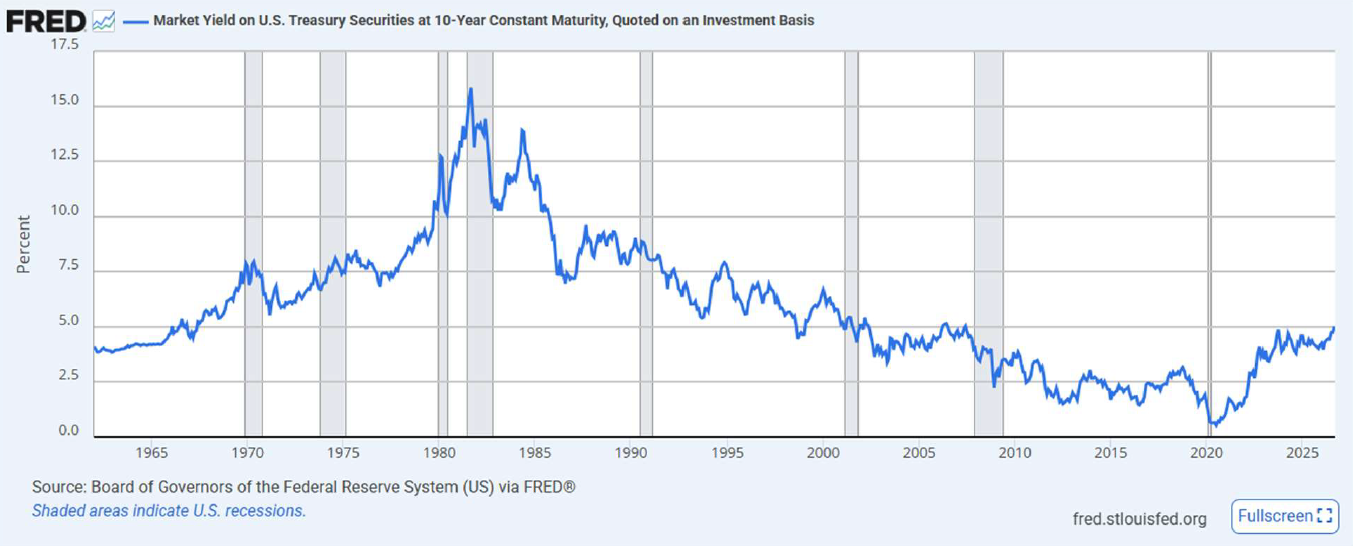
10-Year U.S. Treasury Yield, 1962–2026. Source: FRED, Federal Reserve Bank of St. Louis.
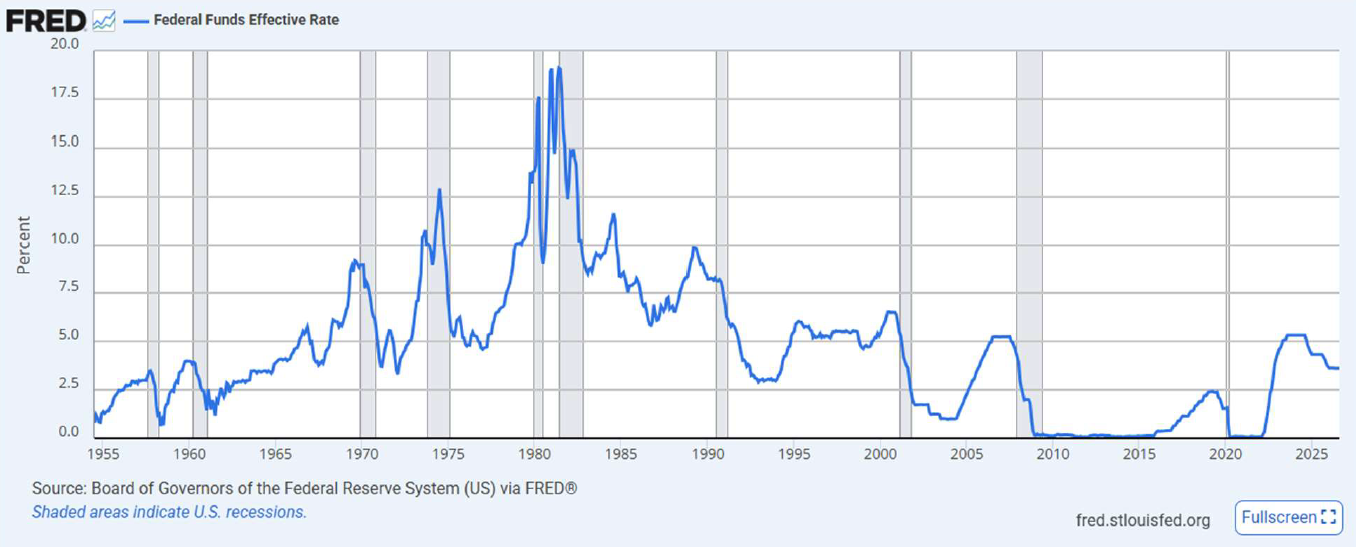
Federal Funds Effective Rate, 1955–2026. Source: FRED, Federal Reserve Bank of St. Louis.
Before 2007, interest rates—whether set by the Fed or reflected in Treasury yields—were routinely much higher. (If you bought a home in the 1980s or '90s, the price was likely far lower than today's, but the mortgage rate was likely far higher.)
In recent years, yields and rates have crept back up. That raises the question: what if today's rates are simply a return to normal, and the ultra-low-rate era was the anomaly—a temporary phase, like arcades or drive-in movie theaters?
If that's the case (and this is a possibility, not a prediction), it would have real implications for markets. Companies and investors have grown accustomed to cheap financing. If higher rates turn out to be the new normal, both may need to be more disciplined with capital as borrowing—and repaying what's borrowed—gets harder. Whether that slows growth is an open question, since the stock market, like bond yields, responds to many ingredients at once.
The honest answer is that we don't know what comes next. Yields and rates could stay elevated, or they could ease. The weight could keep piling on, or the markets could prove strong enough to handle more than expected.
What Should You Do With All of This?
Given how central Treasury yields are to the financial system—and the likelihood that this is a story that evolves rather than resolves—it's worth having a clear picture of what's going on and why it matters. But more information isn't automatically useful unless you know what to do with it.
Back to the gym one more time: imagine having unrestricted access to every machine and free weight. It would be easy to get overexcited and start using everything at once, chasing results as fast as possible—but that approach tends to be unsuccessful, and sometimes unsafe. It's equally possible to go the other direction: to feel so overwhelmed that you stick to one or two familiar exercises, or skip the gym altogether.
The better approach is a measured one: lift thoughtfully, work all the major muscle groups, pay attention to form, and avoid both overtraining and stalling out. The same applies to investing. It means not letting emotion drive decisions—not overreacting to alarming headlines about yields, oil, or inflation, and not getting overly exuberant about AI or the stock market either.
Understanding the “why” behind the headlines is what makes that measured approach possible. It's also what allows you to stay prepared for a higher-rate environment rather than surprised by it.
This is a genuinely interesting period to be an investor—there are a lot of ingredients to weigh and storylines to follow. That can create uncertainty, but it can also create opportunity. If you have questions about how any of this connects to your own portfolio or financial plan, we're always glad to talk it through.
Sources
1. “Market Yield on U.S. Treasury Securities at 10-Year Constant Maturity,” Federal Reserve Bank of St. Louis, https://fred.stlouisfed.org/series/dgs10
2. “Remarks by Secretary of the Treasury Scott Bessent before the Treasury Market Conference,” U.S. Department of the Treasury, https://home.treasury.gov/news/press-releases/sb0314
3. “Who's buying U.S. Treasury debt, and why?” Brookings, https://www.brookings.edu/articles/whos-buying-u-s-treasury-debt-and-why/
4. “Know your bonds: A quick guide to Treasuries,” CNN Business, https://www.cnn.com/2026/09/10/economy/bond-market-treasury-explained
5. “U.S. diesel prices soar past $6 a gallon,” Associated Press, https://apnews.com/article/diesel-prices-record-iran-war-636252b3b82326b41661ee5c4073dacb
6. “Ever Wonder What Percentage of Americans Are in Debt?” National Debt Relief, https://www.nationaldebtrelief.com/blog/financial-wellness/credit-score/ever-wonder-what-percentage-of-americans-are-in-debt/
7. “The Demographics of Household Debt in America,” Debt.org, https://www.debt.org/faqs/americans-in-debt/demographics/
8. “What is the national debt?” U.S. Department of the Treasury, https://fiscaldata.treasury.gov/americas-finance-guide/national-debt/
9. “GDP and Corporate Profits, 2nd Quarter 2026,” Bureau of Economic Analysis, https://www.bea.gov/news/2026/gdp-second-estimate-and-corporate-profits-2nd-quarter-2026
10. “Economy at a Glance – Unemployment Rate,” Board of Governors of the Federal Reserve System, https://www.federalreserve.gov/economy-at-a-glance-unemployment-rate.htm
11. “Federal Reserve issues FOMC statement,” Board of Governors of the Federal Reserve System, https://www.federalreserve.gov/newsevents/pressreleases/monetary20260916a.htm
12. “The AI buildout rests on hidden debt,” GIS, https://www.gisreportsonline.com/r/ai-buildout-hidden-debt/
13. “Market Yield on U.S. Treasury Securities at 10-Year Constant Maturity,” Federal Reserve Bank of St. Louis (Max View), https://fred.stlouisfed.org/series/dgs10
14. “Federal Funds Effective Rate,” Federal Reserve Bank of St. Louis (Max View), https://fred.stlouisfed.org/series/fedfunds
Hilltop Wealth Advisors is a registered investment adviser. Information presented is for educational purposes only and does not intend to make an offer or solicitation for the sale or purchase of any specific securities, investments, or investment strategies. Investments involve risk and, unless otherwise stated, are not guaranteed. Be sure to first consult with a qualified financial adviser and/or tax professional before implementing any strategy discussed herein. Past performance is not indicative of future performance.